Saltline: how AI is changing 3D browser games
How Saltline and Gulmohar Local use AI-generated code, Three.js and WebGL to build on earlier 3D websites and turn small demos into playable browser worlds.
Open a link and you can be standing in a rain-soaked cargo port, moving between containers with a weapon in view. Felix Rieseberg’s Saltline, made with Claude Fable 5.2, makes that experience available in a browser. The first impression is visual. The more interesting change is in the work behind it.
Behind every scene like this is a long list of things to build: objects, surfaces, lighting and the rules that make the world respond. Understanding that work helps explain how AI is changing the path from an idea to a place someone can explore.
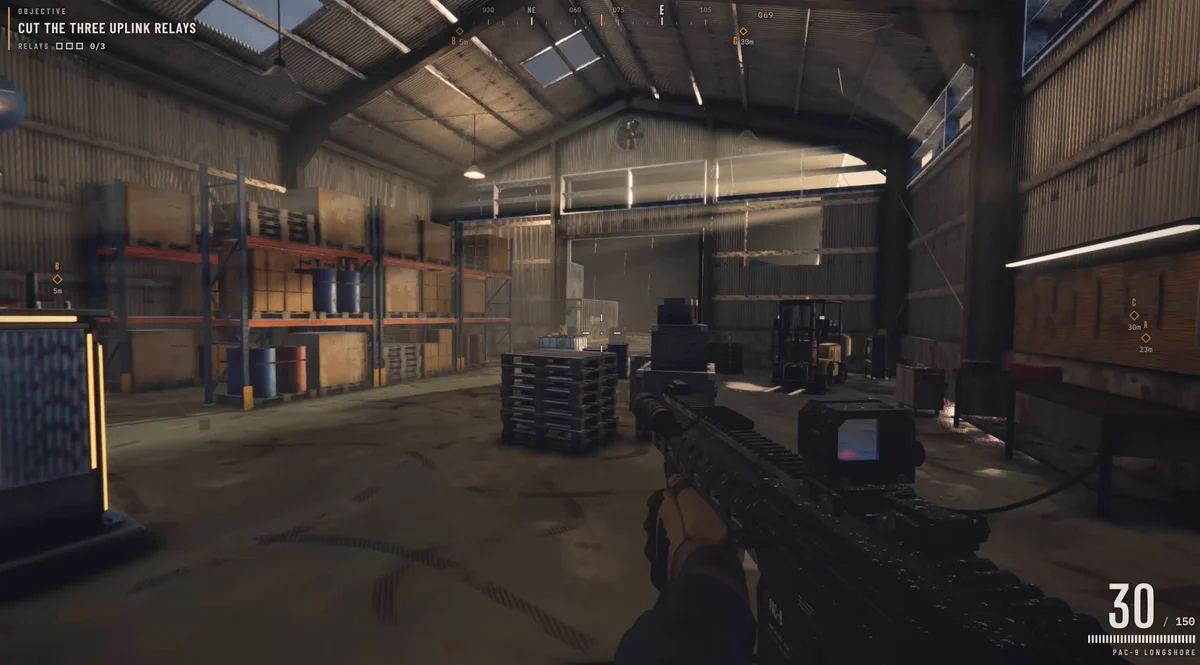
Saltline, from Felix Rieseberg’s published gameplay demo.
The browser could draw it. Someone still had to build it.
A 3D world starts with objects. Walls, wheels and windows are assembled from geometry, often triangles joined into surfaces called meshes. Textures add detail; lighting gives depth; code supplies movement and interaction. Artists can create models in graphics software and export files, while developers can also generate shapes directly in code. Either way, building a coherent scene takes time.
The browser became a more accessible home for that work as WebGL brought hardware-accelerated graphics without plugins, reaching its 1.0 specification in 2011. Libraries such as Three.js made scenes, cameras and materials easier to manage. The device’s graphics hardware draws the result into a canvas on the page.
Developers were already making substantial experiences. Brandon Jones’s 2010 Quake 3 level renderer adapted existing game maps and textures for first-person exploration. Joel Strait’s City Tour generates roads and buildings through rules. These were different construction methods, not primitive steps waiting for AI to make browser 3D possible.
From hand-built scenes to AI-assisted worlds
Creators were already turning websites into places to explore. Andreas Lagerkvist’s portfolio combined Blender models with Three.js; he described the challenge of keeping those models simple enough to run well. Anderson Mancini’s Windland took that craft into a miniature city. Its workflow included modelling, precomputing lighting in Blender and compressing assets for the browser. Mancini reported about two weeks of work alongside his job. The results were already expressive, but getting there required both visual craft and technical preparation.
AI coding tools began making parts of that work easier to attempt. Instead of modelling every object or writing every geometry function yourself, you could describe a scene and ask a model to construct it in code. Glass-aquarium prompts and koi ponds with feeding behaviour became useful informal tests: could the model produce convincing shapes, water and movement together? They showed that AI-assisted 3D creation was possible before Saltline.
The progression now extends from generating a small scene to coordinating more of an experience: a place to move through, things to interact with, and sound and behaviour that support the setting. Earlier craftsmanship still matters, but more of the construction can be delegated and revised. Saltline brings that change into focus through a playable world.
Saltline and Gulmohar Local: 3D worlds built with AI
Rieseberg’s Saltline announcement credits Claude Fable 5.2 with generating models, textures and sounds. The game uses Three.js r180 and WebGL. Its code constructs geometry, draws texture atlases on canvases and generates sound data. A corrugated-steel surface comes from mathematical ridges and noise; the Hound enemy has a code-defined skeleton with joints that can animate. These are assets created through code, rather than every object arriving as a finished model file.
What changes the perception is their combination: a setting, movement, enemies and sound in one playable experience. That makes AI-assisted 3D easier to imagine as a creative workflow beyond a model comparison. It does not establish commercial-game quality. Rieseberg reports an eight-hour initial run and roughly $550 at API pricing; the current version notes two further hours improving weapons, sound and gameplay. Refinement remains part of the work.
Gulmohar Local, by Shardul Nandedkar, offers the same idea through exploration. Its launch presented miniature Mumbai and Bengaluru worlds made with Claude Opus 5.5, with code-generated buildings, trains and characters. Shardul credits an earlier project, GMI Cloud’s Sakura Crossing. The appeal is the place you can explore, built on existing work, rather than a claim to have invented the technique.
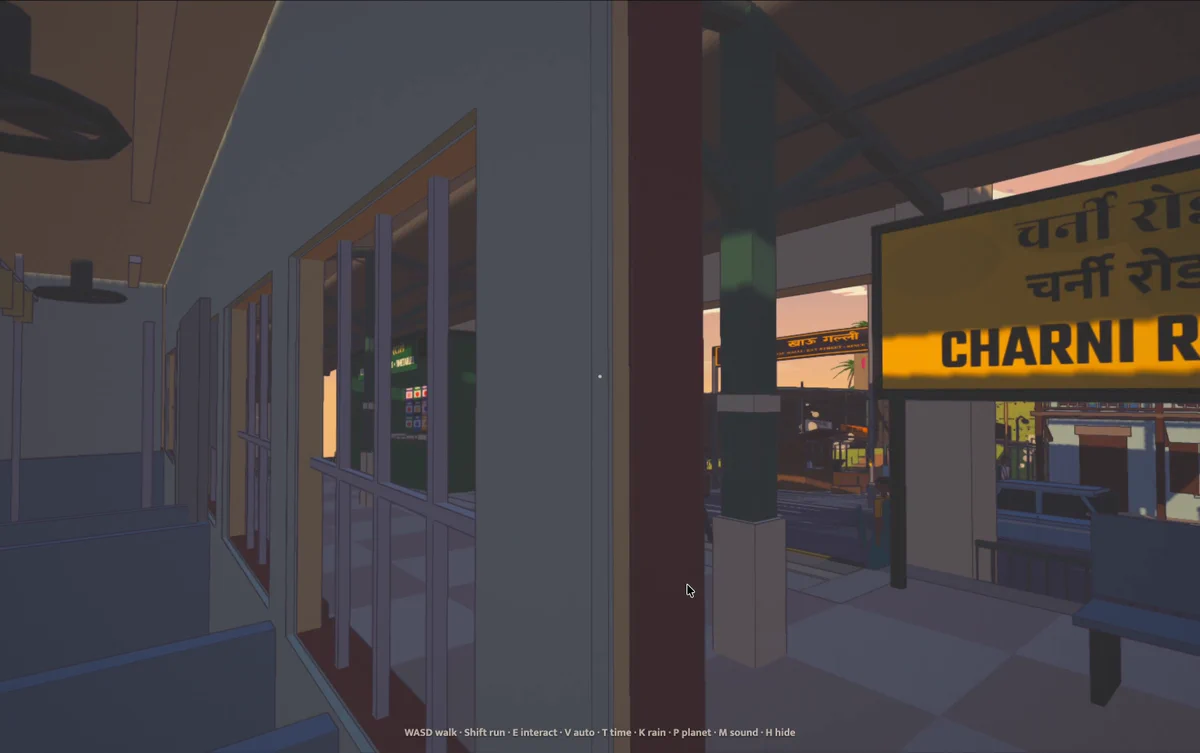
Gulmohar Local, from Shardul Nandedkar’s published demo.
A shorter path from an idea to a world
These locally rendered scenes also differ from cloud gaming, where a remote computer runs the game and streams its picture. Nor does AI-written code automatically make a world model, which generates an environment’s evolution in response to actions.
The shift is in creation: more people can describe, generate and revise the pieces of an interactive world without writing every step themselves. For developers and designers, that can make a small interactive prototype more approachable; performance, controls and accessibility still need testing before it is useful to visitors. Smaller experiments in spatial illustration and motion offer a starting point too. The fish tank demonstrated a capability. Saltline makes it easier to picture what someone might choose to create with it.
Sources and projects
- Play Saltline by Felix Rieseberg.
- Gulmohar Local by Shardul Nandedkar and its predecessor, Sakura Crossing.
- City Tour and Quake 3 WebGL renderer.
Loading content…