Kiri: a Rust Docker Desktop alternative built for fast startup
Kiri rebuilds container startup in Rust while supporting Docker CLI, Compose and buildx. Explore its runtime architecture and reported startup benchmarks.
Running a container usually starts with a familiar Docker command. Kiri changes the engine that answers it. The Rust container runtime runs Docker images and supports the Docker Engine API, so CLI commands, Compose projects and buildx workflows can connect to its runtime.
The Apache-2.0 project offers an alternative to Docker Desktop and OrbStack on macOS, Windows and Linux. Its first launch creates a kiri Docker context, which tells your tools where to send requests. Its approach is to rebuild container startup behind an established interface.
How Kiri’s Rust container runtime works
A fresh implementation gives Kiri room to choose a different process layout. Its architecture brings container creation into a small Rust guest agent, leaving out dockerd, runc and per-container shims. Those choices shorten the machinery a request passes through.
On macOS, the host daemon manages a Linux virtual machine and forwards requests through vsock, a communication channel between host and guest. Inside, the agent uses Linux’s clone3 call to create a process with namespaces for isolation and a cgroup for resource control. The project describes a roughly 900 KB agent and a custom 10 MB kernel.
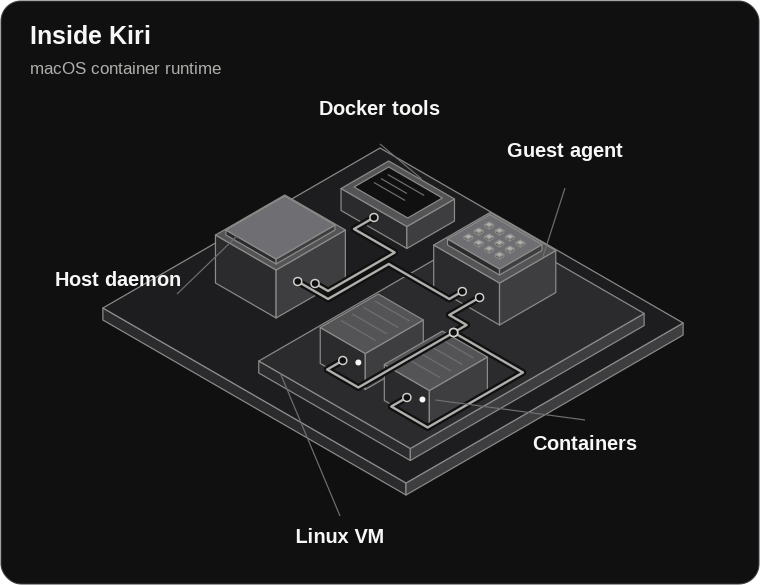
How this differs by platform. The diagram shows macOS, where a Linux virtual machine supplies the kernel containers need. Linux runs Kiri directly on its own kernel; Windows uses WSL2 to provide the Linux environment. In each case, Docker tools send requests to Kiri’s engine, which manages the containers underneath.
Kiri vs Docker Desktop: startup benchmarks
Kiri’s README reports 2.55 ms versus Docker Desktop’s 213 ms for an Alpine container running true and being removed through the Docker API—the basis of its roughly 80× figure. These are medians from 30 runs.
The project’s separate November 2 benchmark records the following medians with images already present:
| Container lifecycle | Kiri | Docker Desktop |
|---|---|---|
| Through the Docker API | 3.1 ms | 163 ms |
Through docker run --rm alpine true |
22 ms | 178 ms |
That run used an M3 Max on macOS 27.0.1, Kiri 0.1.13 and Docker Desktop 4.90.0, each allocated two CPUs and 8 GB, with 30 samples after three warmups.
For repeated container creation in local development, that is the work Kiri aims to shorten. Its beta brings a different runtime design to an established workflow: the command stays familiar, while the path from that command to a container is rebuilt.
Loading content…