Kawa puts virtual topics and access rules in front of Kafka
How the Kawa Kafka gateway rewrites broker addresses, maps virtual topics and applies access rules, and what to measure before putting it in the request path.
Change the Kafka topic behind your application without updating the topic name in every consumer. That’s the idea behind Kawa’s virtual topics. Applications use a stable name, while the gateway maps it to the topic that actually stores the events.
Kawa, a Kafka gateway from Jonas Geiregat, sits between your applications and Kafka. Alongside topic mapping, it can control access and filter the events consumers receive. The project tagged v0.1.0 on October 29.
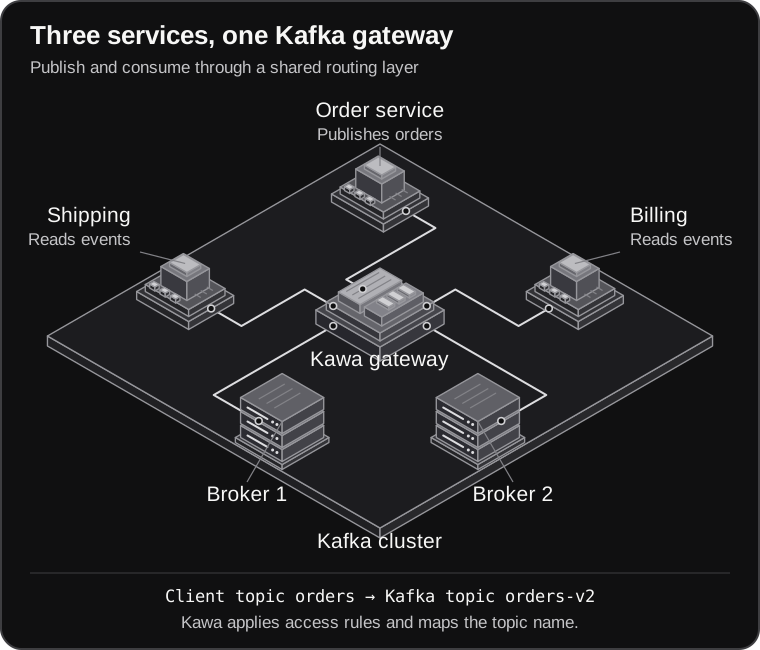
Kafka gateway. A gateway sits between applications and Kafka’s brokers, the servers that store and serve events. Services connect their Kafka clients to Kawa, which forwards their requests to the brokers. They can keep their existing client libraries, with connection settings updated for the gateway.
How Kawa stays in the request path
Connecting to Kafka involves more than knowing its initial address. A client asks the cluster which broker handles the data it needs, then connects to the addresses returned. Producers and consumers both rely on this discovery process.
Kawa understands those Kafka requests and replies. It replaces broker and group coordinator addresses in discovery replies with its own advertised address, keeping subsequent client connections going through the gateway. It then routes requests to the appropriate broker.
That position lets Kawa apply rules to requests and translate the topic names services use. Producers and consumers can use the same virtual name for writes and reads.
Change the mapping, keep the topic name
For example, applications can publish to and read from orders, while Kawa routes those requests to orders-v2 in Kafka. The alias is configured in the gateway. Applications using it can keep the name orders when that mapping changes.
That distinction matters during a migration. Updating the mapping can redirect requests, but moving existing events, preserving consumer positions and handling changes to the event format still require planning. A stable name removes one dependency that would otherwise be embedded in every subscribing service.
Kawa can also give consumers filtered views of a topic. Shipping might receive only orders ready for dispatch, while billing reads the broader stream. Role-based access rules control what each client may do, and governance rules can constrain operations such as creating topics or changing partition counts.
Those capabilities add another step to the request path. The tagged project provides no published throughput or latency baseline, so its cost needs to be measured with the application’s own traffic.
Kawa gives you a place to manage topic mappings and access rules as the application grows. For consumers already connected through it, a change to the underlying topic can become a gateway configuration update, with their familiar topic name still in place.
Sources
Loading content…