Inkling 2 Mini on Apple Silicon and NVIDIA GB10
How Gall and Rustling run Inkling 2 Mini on Apple Silicon, and what Runtime Notes measured with tuned vLLM on a single NVIDIA GB10.
A coding model can fit on your laptop’s drive and still leave too little memory to work through a long prompt. Inkling 2 Mini approaches that problem at the model level: it does more work per token by reusing layers it already has. Two Apple Silicon runtimes take it from there. Gall shows what fits on a 24 GB MacBook Air, and Rustling shows how a coding client can talk to the model through a local API. On NVIDIA hardware, an independent GB10 test shows what a tuned vLLM setup can deliver.
Thinking Machines Lab released Mini on November 20. The original model accepts text and images, produces text and tool calls, and is available through Tinker or as an Apache 2.0 download. It builds on Inkling 2 Small’s four-bit training recipe, which stores each expert weight in fewer bits. Mini also cuts the number of weights it needs to store.
What counts as one pass?
Inkling generates text one token at a time. Thinking Machines describes a network with 24 layers arranged in four blocks of six. For each token, the first block runs once. The two middle blocks then run together, from layer 7 through layer 18. One trip through those twelve layers is one pass. After three passes, the final block runs once and the model predicts the next token.
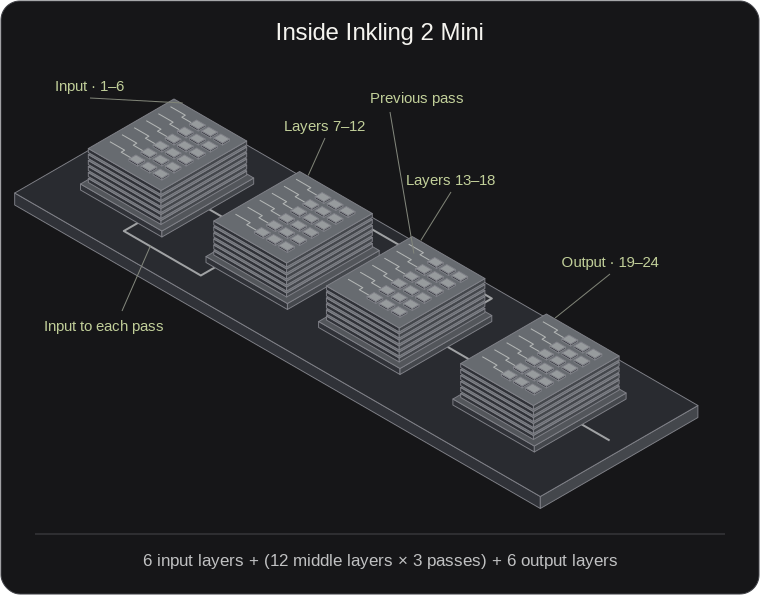
Those 24 stored layers do 48 layer operations per token. Each trip through the middle pair starts with the first block’s output. On the second and third trips, the model also reads a message from the previous pass. A gate learned during training determines how much of that message to use.
That gives each token more processing without another copy of the middle layers. To shrink the checkpoint itself, the lab also kept fewer experts.
How the model fits in memory
Each expert layer started with its own pool of 384 experts, or groups of weights the model can choose among. Thinking Machines kept the 128 most-used experts in each layer. Different layers keep different pools; when the loop revisits a layer, it uses that layer’s existing pool.
Dropping two-thirds of each pool freed memory, but it also removed weights the model had learned to use. The lab trained the smaller network on one trillion tokens distilled from a larger Inkling model so the remaining experts could pick up that work.
Mini stores 26.4 billion parameters across the whole model. Its routing selects 3.4 billion distinct parameters per token. Counting repeated uses in the middle layers brings that to 5.4 billion weight activations.
Most expert weights are stored at four-bit precision; the final four layers use eight-bit precision. This brings the original checkpoint to about 20 GB on disk.
How Mini compares with Qwen
Qwen3.8-27B has a similar total parameter count. In Thinking Machines’ release benchmarks, Mini led by six percentage points on software engineering tasks and by 17.4 points on difficult web research. Qwen held a small lead on the terminal benchmark.
| Benchmark | What it tests | Inkling 2 Mini | Qwen3.8-27B |
|---|---|---|---|
| DeepSWE v1.1 | Resolving software engineering tasks | 48.2% | 42.2% |
| BrowseComp | Finding difficult answers on the web | 79.0% | 61.6% |
| MCP Atlas Public | Completing tasks with connected tools | 82.7% | 77.3% |
| Terminal Bench v2.1 | Working in a terminal | 71.6% | 73.0% |
Artificial Analysis gave Mini and Qwen the same overall Intelligence Index score. Mini produced about 38% more output tokens, while the evaluator estimated that Mini used roughly 36% of Qwen’s compute.
What do the extra passes change?
To isolate the effect of looping, Thinking Machines tested a separate variable-loop research model. More passes helped it follow longer chains of references in supplied material, while recall without reference material barely changed. On Think Fast, the model had to answer directly without writing intermediate steps. At one pass it got half the tasks right at a difficulty that takes a human about 16 seconds. At three passes that rose to 37 seconds before largely leveling off.
The team also checked whether shorter written reasoning made the research model harder to supervise. In its initial tests, the reasoning remained readable and longer loops showed no clear pattern of making undisclosed side tasks more successful.
The loop changes how the model spends its compute. Running it locally brings a different constraint: the weights and the active conversation have to share the Mac’s memory.
How Gall runs Mini on a 24 GB Mac
Thinking Machines lists Apple Silicon Macs with 32 GB or more for the original checkpoint. Gall uses a more compact version of the weights from Unsloth. Its Rust host and custom Metal GPU kernels read the 12.7 GB GGUF file in place, avoiding a larger copy in memory.
Gall’s maintainer measured a 5.3 GB server footprint with an 805-token prompt on a 24 GB M2 MacBook Air. Allowing for the full 12.7 GB weights file brings the estimated memory budget to about 18 GB. The maintainer now reports about 25 tokens per second at short context on that Mac. Their longer-context measurements show 16.2–16.5 at roughly 30,000 tokens.
Gall unloads the model after one idle second by default. It can save conversation state for prefixes of at least 512 tokens, so a later turn can reuse that work without keeping the model in memory between requests. The current macOS menu bar app also serves OpenAI- and Anthropic-compatible APIs, with support for image inputs and structured JSON output.
Rustling brings a local OpenAI-compatible API to coding tools
Shown publicly on November 25, Rustling is another independent runtime for Inkling 2 Mini on Apple Silicon. Its Rust and Metal engine can run as a local server. An app that normally sends requests to a hosted API can point to Rustling’s local address and keep the model computation on the Mac.
The server implements both Chat Completions and Responses, with streamed replies and tool calls. The project shows how to point Codex, Aider and OpenCode at the default local base URL, http://127.0.0.1:8080/v1. Codex uses the Responses endpoint. These are OpenAI request formats; Inkling 2 Mini is still the model answering. Requests are processed one at a time, and the server does not implement the model’s image input.
For a coding client, the first request often carries a large prompt: instructions, tool definitions and conversation history. Rustling can cache processed prompts in memory and on disk, so it can reuse a matching prefix on another request, even after a restart. There’s also a standalone terminal chat with file reading and search, if you want to try it without another client.
Rustling’s default weights take 16.6 GB on disk, compared with 12.7 GB for Gall’s quantization. Conversation state and prompt processing require more memory. Rustling’s maintainer measured on a 64 GB Mac and reports that long prompts can slow down even on 32 GB. That leaves less room for long coding sessions on a 24 GB Mac.
For a 24 GB Mac, Gall has the clearer hardware evidence: its maintainer tested that memory tier directly. Rustling is an option when you want to connect a text-based coding client to the model locally. To find out whether either fits your work, start with a prompt the size your client normally sends and check the time to the first token as well as the speed once the model starts replying.
Running Inkling 2 Mini on one NVIDIA GB10
On NVIDIA hardware, the question shifts from fitting the model on a laptop to keeping it responsive under load. In its November 27 benchmark, Runtime Notes ran Inkling 2 Mini with tuned vLLM on an MSI EdgeXpert with one NVIDIA GB10 chip and 128 GB of shared memory. Inkling was allocated 36% of that memory, with Qwen3.8-27B loaded but idle during the measurements.
| Workload | Runtime Notes result |
|---|---|
| One request, benchmark suite | 101 output tokens/s |
| Four concurrent requests, same suite | 195.7 output tokens/s combined |
| Coding, prose and reasoning prompts at model defaults | About 70 output tokens/s (geometric mean) |
| Fresh prompt of roughly 32,000 tokens | 9.7 seconds to the first token |
The tuned setup uses speculative decoding: a smaller DFlash2 model guesses the next tokens and Inkling checks them together. Runtime Notes also tuned the GPU work that reads long prompts. For a coding session, those are two distinct waits: how long until the reply starts, and how quickly it arrives after that. The GB10 and Mac measurements use different runtimes and workloads, so they answer different questions rather than forming a hardware ranking.
Sources
- Thinking Machines Lab’s release, flight demo and benchmark tables
- Technical model card and variable-loop evaluations
- Model weights and license on Hugging Face
- Artificial Analysis comparison of intelligence, tokens and compute
- Gall’s Metal runtime, memory budget and M2 MacBook Air measurements
- Rustling’s API documentation, terminal chat and memory requirements
- Runtime Notes: Getting 101 tok/s from Inkling 2 Mini in vLLM on one GB10
Loading content…